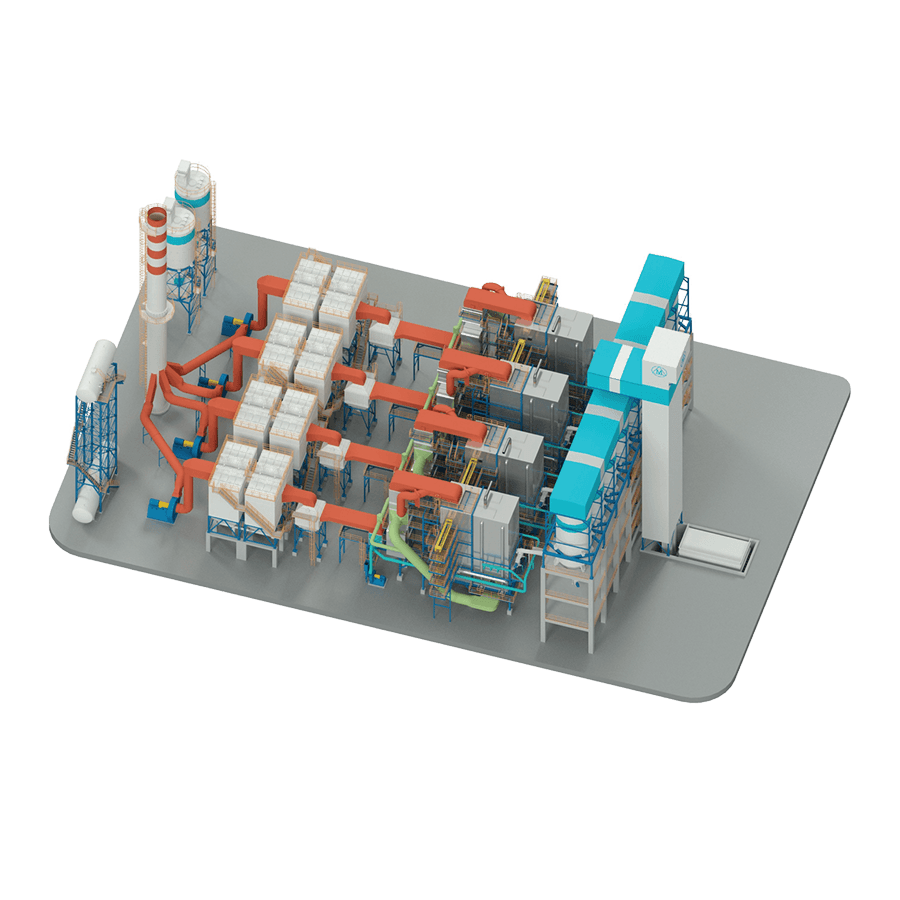
“Boilers play a crucial role in medical glove production, ensuring precise heat control for material preparation, vulcanization, shaping, and auxiliary processes.”
THE ROLE OF BOILERS IN THE PRODUCTION PROCESS OF MEDICAL GLOVES
INTRODUCTION
Boilers are indispensable in medical glove manufacturing, providing efficient energy solutions critical to quality and performance optimization. This article explores how boilers play a pivotal role in each stage of the production process, from raw material preparation to the final product’s perfection.

Figure: Medical glove manufacturing
1- The importance of heat in softening raw materials
The first stage of medical glove production begins with softening and processing raw materials. Boilers generate the heat required to soften natural rubber, ensuring its elasticity, flexibility, and softness are optimized. This process guarantees that the rubber meets strict medical-grade standards. By ensuring uniform heating, boilers contribute to the consistent quality of the raw materials, which directly impacts the gloves’ performance.
Moreover, the precise heat control provided by boilers eliminates irregularities during this phase. Consequently, manufacturers can produce rubber that adheres to stringent production requirements, setting the foundation for superior medical gloves.
2- Rubber vulcanization: Enhancing durability and resilience
Another critical stage in glove manufacturing is rubber vulcanization, which relies heavily on boilers for temperature and pressure control. Boilers provide the ideal conditions needed to enhance the gloves’ durability and elasticity. In addition, this stage improves fire resistance, chemical resistance, and heat tolerance, ensuring that the gloves meet diverse usage demands in the medical field.
Through efficient energy transfer, boilers ensure a seamless vulcanization process. With proper pressure management, they prevent material defects, allowing gloves to withstand rigorous medical applications.
3- Final shaping and cooling: Achieving perfection
Once the rubber is vulcanized, boilers again play an essential role in shaping and cooling the gloves. This process ensures that the gloves reach their final hardness, size, and shape. The heat management from boilers eliminates potential defects, such as air bubbles or uneven surfaces, that might compromise the product’s quality.
Additionally, stable temperature control during cooling guarantees the gloves retain their desired physical properties. This meticulous process is vital for delivering gloves that meet industry standards and user expectations.
4- Supporting auxiliary processes with boilers
Beyond direct glove production, boilers facilitate the processing of essential auxiliary materials. These include additives, treatment chemicals, and other components critical to glove manufacturing. By maintaining consistent heat, boilers ensure these materials are prepared to the exact specifications required for high-quality gloves.
This integration of boilers into auxiliary processes not only enhances efficiency but also reduces waste, making the entire production system more sustainable.
5- Exploring alternatives: Thermal oil heaters in glove manufacturing
While boilers remain a staple in glove production, thermal oil heaters are gaining popularity as an efficient alternative. These heaters offer precise temperature control without generating steam, providing stable performance throughout the manufacturing process. Their ability to maintain consistent heat makes them a preferred choice for manufacturers seeking innovative energy solutions.
CONCLUSION
In conclusion, boilers are at the heart of medical glove production, ensuring every step, from raw material processing to final shaping, is carried out with precision. Their contribution to quality, efficiency, and sustainability highlights their indispensable role in the industry.
(Vn-Industry.)
Home page: https://vn-industry.com/